
Transfer Rate Converter
Conversion Results
💡 Tip: Auto-converts as you type!
Network Tools
Kbps to Gbps Converter: Converting Kilobits to Gigabits per Second
Understanding Kbps to Gbps Conversion
Converting Kbps to Gbps helps understand the massive scale difference between basic internet speeds and modern fiber connections. Whether you’re upgrading from legacy systems to gigabit internet or comparing different networking technologies, understanding kilobits per second to gigabits per second conversion is essential for network planning and technology evaluation.
How Many Kbps in 1 Gbps?
1 Gbps = 1,000,000 Kbps (SI standard) or 1 Gbps = 1,048,576 Kbps (IEC standard)
This fundamental relationship shows the enormous leap from kilobit to gigabit speeds, representing a million-fold increase in data transmission capability.
Kbps to Gbps Conversion Formulas
SI Standard (Decimal System)
Formula: Gbps = Kbps ÷ 1,000,000
Examples:
- 56 Kbps to Gbps: 56 ÷ 1,000,000 = 0.000056 Gbps
- 1,000,000 Kbps to Gbps: 1,000,000 ÷ 1,000,000 = 1 Gbps
IEC Standard (Binary System)
Formula: Gbps = Kbps ÷ 1,048,576
Examples:
- 56 Kbps to Gbps: 56 ÷ 1,048,576 = 0.0000534 Gbps
- 1,048,576 Kbps to Gbps: 1,048,576 ÷ 1,048,576 = 1 Gbps
Common Kbps to Gbps Conversions
| Kbps Value | Gbps (SI) | Gbps (IEC) | Technology Example |
|---|---|---|---|
| 56 Kbps | 0.000056 Gbps | 0.0000534 Gbps | Dial-up modem |
| 128 Kbps | 0.000128 Gbps | 0.000122 Gbps | Basic ISDN |
| 1,000 Kbps | 0.001 Gbps | 0.000954 Gbps | 1 Mbps broadband |
| 10,000 Kbps | 0.01 Gbps | 0.00954 Gbps | 10 Mbps connection |
| 100,000 Kbps | 0.1 Gbps | 0.0954 Gbps | 100 Mbps fiber |
| 1,000,000 Kbps | 1 Gbps | 0.954 Gbps | Gigabit internet |
Technology Evolution and Speed Comparison
Legacy Technology Speeds
Dial-up modems at 56 Kbps convert to 0.000056 Gbps, highlighting how dramatically internet speeds have evolved. Early ISDN connections at 128 Kbps equal 0.000128 Gbps, still microscopic compared to modern standards.
Modern Internet Services
Today’s gigabit fiber services operate at 1,000,000 Kbps (1 Gbps), representing nearly 18,000 times faster than dial-up speeds. Multi-gigabit plans at 2,000,000-10,000,000 Kbps (2-10 Gbps) are becoming available in major metropolitan areas.
Enterprise and Data Center Applications
10 Gigabit Ethernet operates at 10,000,000 Kbps (10 Gbps), while 100 Gigabit networks reach 100,000,000 Kbps (100 Gbps). These speeds enable cloud computing, video streaming services, and large-scale data processing applications.
Practical Applications
Network Upgrade Planning
Converting legacy kilobit speeds to gigabit equivalents helps quantify infrastructure improvements. Upgrading from 1,500 Kbps DSL (0.0015 Gbps) to 1,000,000 Kbps fiber (1 Gbps) represents a 667x speed increase.
IoT and Sensor Networks
Many IoT devices transmit at 1-10 Kbps (0.000001-0.00001 Gbps), requiring minimal bandwidth. Understanding these micro-speeds helps optimize network resources and plan IoT deployments efficiently.
Capacity Planning
Enterprise networks handling thousands of users need multi-gigabit capacity. Converting individual user requirements from Kbps to Gbps helps calculate total infrastructure needs and plan network architecture.
Speed Requirements by Application
Video Streaming Comparison
- Standard Definition: 1,000 Kbps (0.001 Gbps)
- HD Video: 5,000 Kbps (0.005 Gbps)
- 4K Streaming: 25,000 Kbps (0.025 Gbps)
- 8K Content: 100,000 Kbps (0.1 Gbps)
Business Applications
- Email/Web: 100-500 Kbps (0.0001-0.0005 Gbps) per user
- Video Conferencing: 2,000-8,000 Kbps (0.002-0.008 Gbps)
- Cloud Applications: 5,000-20,000 Kbps (0.005-0.02 Gbps)
- File Servers: 50,000-500,000 Kbps (0.05-0.5 Gbps)
Using Our Kbps to Gbps Converter
Our professional converter handles extreme scale differences:
- Enter Kbps values from legacy to modern speeds
- Select conversion standard (SI or IEC)
- View precise Gbps results with scientific notation
- Compare scale differences between technologies
The tool automatically formats results for readability, using scientific notation for very small values and providing context for massive speed differences.
Future Technology Trends
Emerging Gigabit Standards
5G networks promise speeds exceeding 1,000,000 Kbps (1 Gbps), while satellite internet services target 100,000-500,000 Kbps (0.1-0.5 Gbps) globally.
Next-Generation Infrastructure
Terabit networks operating at 1,000,000,000,000 Kbps (1,000 Gbps) are emerging for backbone infrastructure, supporting the massive bandwidth requirements of cloud computing and AI applications.
Frequently Asked Questions
How many Kbps in 1 Gbps?
1 Gbps equals 1,000,000 Kbps using the SI standard, or 1,048,576 Kbps using the IEC standard. This represents the enormous scale difference between kilobit and gigabit speeds.
How do you convert Kbps to Gbps?
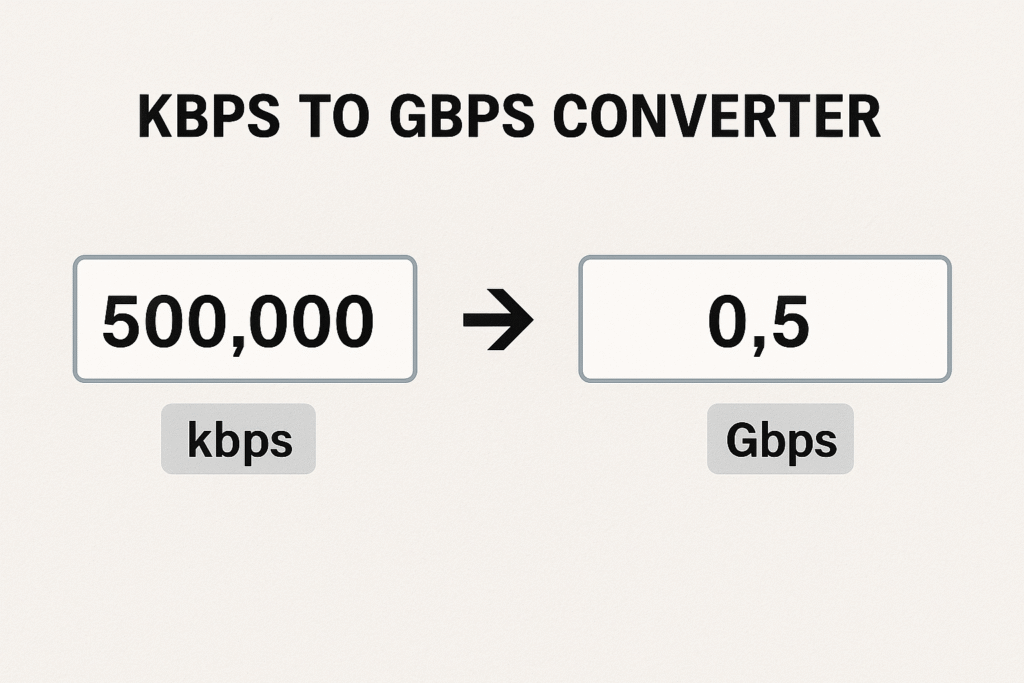
To convert Kbps to Gbps, divide by 1,000,000 (SI) or 1,048,576 (IEC). Example: 500,000 Kbps ÷ 1,000,000 = 0.5 Gbps.
Why is Kbps to Gbps conversion important?
Kbps to Gbps conversion helps understand technology evolution, from dial-up modems (56 Kbps) to modern fiber internet (1,000,000+ Kbps). It’s essential for network planning and infrastructure comparison.
What’s the difference between Kbps and Gbps speeds?
Kbps measures thousands of bits per second, while Gbps measures billions of bits per second. Gbps is 1,000,000 times larger than Kbps, representing the leap from legacy to modern networking.
When would you need Kbps to Gbps conversion?
Common scenarios include: upgrading from legacy systems, planning IoT networks with mixed speeds, comparing historical vs. modern internet speeds, and enterprise capacity planning across different technologies.
Ready to convert Kbps to Gbps? Use our free converter for accurate results across the entire speed spectrum, from legacy kilobit connections to modern gigabit networks. Perfect for network planning and technology comparison.
Learn more about data rate units on Wikipedia.